Web Design
Scalable AI Learning Management System
This app was created to help different organization and schools for a real-life scenarios learning method.
Year :
2026
Industry :
SaaS & Tech
Client :
Private
Project Duration :
8 weeks

Project overview :
This LMS project is about harnessing the power of behavioural science to improve various use cases: training, coaching, consulting and more. This aim to create a real life scenario to train different organization. Unlike other learning management system, this application will allow user or trainer to create their own personal AI Assistant/Coach to better teach with with scenarios that more fitted on their training.
Problem
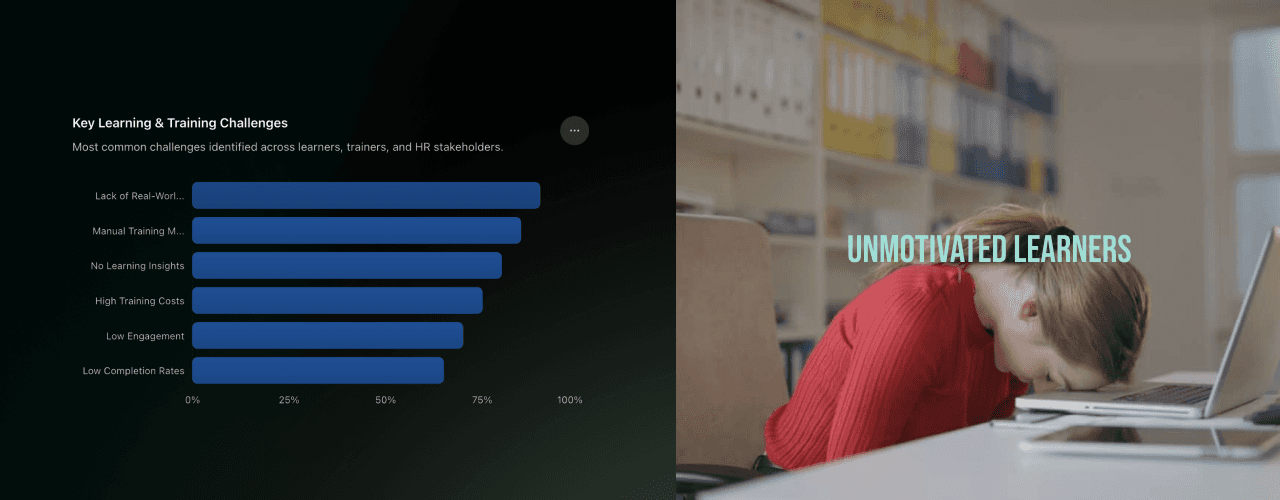
Schools and universities struggle to prepare learners for real-world work environments using traditional, static training methods. As a result, up to 40% of learners show reduced performance, training programs require 20–30% additional days, and organizations incur 20–35% higher costs due to re-training and delayed productivity.
Without immersive, experiential, and adaptive learning tools, both learners and employers experience inefficiency, financial loss, and slower workforce readiness.
Solution
To address these challenges, we designed an AI-powered Learning Management System that transforms traditional learning into an interactive, simulation-based experience.
The platform leverages customizable AI agents, adaptive learning paths, predictive analytics, and real-time performance insights to help learners develop practical skills in realistic environments.
Process
Designing the AI-powered LMS posed the challenge of balancing complex functionality with a simple, intuitive user experience for Administrators, Trainers, and Learners. Therefore, the design process we followed was user-centered and data-driven, focused on identifying user needs and continuously improving the experience.
It began with Information Gathering & Research where existing workflows, pain points, and user journeys were analyzed to uncover usability issues and opportunities for improvement. Next, during Wireframing & Interaction Design, multiple layout concepts and navigation structures were explored through low-fidelity wireframes and rapid prototyping to evaluate different solutions. Finally, through Usability Testing & Iteration, designs were tested with users to identify areas of confusion and friction, allowing refinements to labels, hierarchy, navigation, and interactions.
This iterative process ensured the final solution was intuitive, efficient, and aligned with user expectations.

Ideate
During this process, our main target is to make it the user interface as simply yet accessible to non techy users. The design system below and lo-fi wireframe will showcase the main pages to solve the problems some learners experiencing. The LMS redesign focused on creating a modern, scalable, and AI-driven learning ecosystem that bridges the gap between theoretical education and real-world application.
Dashboard - This page integrates predictive performance analytics that generate risk scores, detect early drop-off trends, and trigger at-risk learner alerts—enabling administrators to intervene up to 30% earlier before performance declines.
Services - The AI-powered Services page transforms learning into interactive simulation-based training by embedding dedicated AI agents into each class that provide real-time conversational feedback.
Character - Introduces a fully customizable AI Persona Studio designed to enhance psychological realism. Users can tailor tone, empathy level, communication style, and cultural context to match specific training needs.
Stimulation Page - The Simulation Page introduces a live AI interaction workspace where learners engage in natural language conversations with context-aware AI agents that adapt in real time.

Key Learnings
Working on this AI-powered Learning Management System (LMS) case study reinforced not only the importance of solving user problems but also designing scalable, business-driven digital products. Throughout the project, I gained valuable insights into balancing user needs, technical feasibility, AI innovation, and product strategy. Below are the key learnings from the entire UX/UI design process.
User-Centered Design is the Foundation - Every design decision should begin with understanding the users' goals, frustrations, and behaviors rather than assumptions. Research provides the direction for meaningful solutions.
Simplicity Solves Complexity - Even highly complex systems can feel intuitive by prioritizing essential actions, reducing unnecessary steps, and organizing information through clear visual hierarchy.
Different User Roles Require Different Experiences - Designing for learners, trainers, administrators, and HR taught me that each user has unique goals, requiring personalized workflows while maintaining a consistent design language.

More Projects


Web Design
Scalable AI Learning Management System
This app was created to help different organization and schools for a real-life scenarios learning method.
Year :
2026
Industry :
SaaS & Tech
Client :
Private
Project Duration :
8 weeks
Project overview :
This LMS project is about harnessing the power of behavioural science to improve various use cases: training, coaching, consulting and more. This aim to create a real life scenario to train different organization. Unlike other learning management system, this application will allow user or trainer to create their own personal AI Assistant/Coach to better teach with with scenarios that more fitted on their training.
Problem
Schools and universities struggle to prepare learners for real-world work environments using traditional, static training methods. As a result, up to 40% of learners show reduced performance, training programs require 20–30% additional days, and organizations incur 20–35% higher costs due to re-training and delayed productivity.
Without immersive, experiential, and adaptive learning tools, both learners and employers experience inefficiency, financial loss, and slower workforce readiness.
Solution
To address these challenges, we designed an AI-powered Learning Management System that transforms traditional learning into an interactive, simulation-based experience.
The platform leverages customizable AI agents, adaptive learning paths, predictive analytics, and real-time performance insights to help learners develop practical skills in realistic environments.
Process
Designing the AI-powered LMS posed the challenge of balancing complex functionality with a simple, intuitive user experience for Administrators, Trainers, and Learners. Therefore, the design process we followed was user-centered and data-driven, focused on identifying user needs and continuously improving the experience.
It began with Information Gathering & Research where existing workflows, pain points, and user journeys were analyzed to uncover usability issues and opportunities for improvement. Next, during Wireframing & Interaction Design, multiple layout concepts and navigation structures were explored through low-fidelity wireframes and rapid prototyping to evaluate different solutions. Finally, through Usability Testing & Iteration, designs were tested with users to identify areas of confusion and friction, allowing refinements to labels, hierarchy, navigation, and interactions.
This iterative process ensured the final solution was intuitive, efficient, and aligned with user expectations.
Ideate
During this process, our main target is to make it the user interface as simply yet accessible to non techy users. The design system below and lo-fi wireframe will showcase the main pages to solve the problems some learners experiencing. The LMS redesign focused on creating a modern, scalable, and AI-driven learning ecosystem that bridges the gap between theoretical education and real-world application.
Dashboard - This page integrates predictive performance analytics that generate risk scores, detect early drop-off trends, and trigger at-risk learner alerts—enabling administrators to intervene up to 30% earlier before performance declines.
Services - The AI-powered Services page transforms learning into interactive simulation-based training by embedding dedicated AI agents into each class that provide real-time conversational feedback.
Character - Introduces a fully customizable AI Persona Studio designed to enhance psychological realism. Users can tailor tone, empathy level, communication style, and cultural context to match specific training needs.
Stimulation Page - The Simulation Page introduces a live AI interaction workspace where learners engage in natural language conversations with context-aware AI agents that adapt in real time.
Key Learnings
Working on this AI-powered Learning Management System (LMS) case study reinforced not only the importance of solving user problems but also designing scalable, business-driven digital products. Throughout the project, I gained valuable insights into balancing user needs, technical feasibility, AI innovation, and product strategy. Below are the key learnings from the entire UX/UI design process.
User-Centered Design is the Foundation - Every design decision should begin with understanding the users' goals, frustrations, and behaviors rather than assumptions. Research provides the direction for meaningful solutions.
Simplicity Solves Complexity - Even highly complex systems can feel intuitive by prioritizing essential actions, reducing unnecessary steps, and organizing information through clear visual hierarchy.
Different User Roles Require Different Experiences - Designing for learners, trainers, administrators, and HR taught me that each user has unique goals, requiring personalized workflows while maintaining a consistent design language.
More Projects
Web Design
Scalable AI Learning Management System
This app was created to help different organization and schools for a real-life scenarios learning method.
Year :
2026
Industry :
SaaS & Tech
Client :
Private
Project Duration :
8 weeks
Project overview :
This LMS project is about harnessing the power of behavioural science to improve various use cases: training, coaching, consulting and more. This aim to create a real life scenario to train different organization. Unlike other learning management system, this application will allow user or trainer to create their own personal AI Assistant/Coach to better teach with with scenarios that more fitted on their training.
Problem
Schools and universities struggle to prepare learners for real-world work environments using traditional, static training methods. As a result, up to 40% of learners show reduced performance, training programs require 20–30% additional days, and organizations incur 20–35% higher costs due to re-training and delayed productivity.
Without immersive, experiential, and adaptive learning tools, both learners and employers experience inefficiency, financial loss, and slower workforce readiness.
Solution
To address these challenges, we designed an AI-powered Learning Management System that transforms traditional learning into an interactive, simulation-based experience.
The platform leverages customizable AI agents, adaptive learning paths, predictive analytics, and real-time performance insights to help learners develop practical skills in realistic environments.
Process
Designing the AI-powered LMS posed the challenge of balancing complex functionality with a simple, intuitive user experience for Administrators, Trainers, and Learners. Therefore, the design process we followed was user-centered and data-driven, focused on identifying user needs and continuously improving the experience.
It began with Information Gathering & Research where existing workflows, pain points, and user journeys were analyzed to uncover usability issues and opportunities for improvement. Next, during Wireframing & Interaction Design, multiple layout concepts and navigation structures were explored through low-fidelity wireframes and rapid prototyping to evaluate different solutions. Finally, through Usability Testing & Iteration, designs were tested with users to identify areas of confusion and friction, allowing refinements to labels, hierarchy, navigation, and interactions.
This iterative process ensured the final solution was intuitive, efficient, and aligned with user expectations.
Ideate
During this process, our main target is to make it the user interface as simply yet accessible to non techy users. The design system below and lo-fi wireframe will showcase the main pages to solve the problems some learners experiencing. The LMS redesign focused on creating a modern, scalable, and AI-driven learning ecosystem that bridges the gap between theoretical education and real-world application.
Dashboard - This page integrates predictive performance analytics that generate risk scores, detect early drop-off trends, and trigger at-risk learner alerts—enabling administrators to intervene up to 30% earlier before performance declines.
Services - The AI-powered Services page transforms learning into interactive simulation-based training by embedding dedicated AI agents into each class that provide real-time conversational feedback.
Character - Introduces a fully customizable AI Persona Studio designed to enhance psychological realism. Users can tailor tone, empathy level, communication style, and cultural context to match specific training needs.
Stimulation Page - The Simulation Page introduces a live AI interaction workspace where learners engage in natural language conversations with context-aware AI agents that adapt in real time.
Key Learnings
Working on this AI-powered Learning Management System (LMS) case study reinforced not only the importance of solving user problems but also designing scalable, business-driven digital products. Throughout the project, I gained valuable insights into balancing user needs, technical feasibility, AI innovation, and product strategy. Below are the key learnings from the entire UX/UI design process.
User-Centered Design is the Foundation - Every design decision should begin with understanding the users' goals, frustrations, and behaviors rather than assumptions. Research provides the direction for meaningful solutions.
Simplicity Solves Complexity - Even highly complex systems can feel intuitive by prioritizing essential actions, reducing unnecessary steps, and organizing information through clear visual hierarchy.
Different User Roles Require Different Experiences - Designing for learners, trainers, administrators, and HR taught me that each user has unique goals, requiring personalized workflows while maintaining a consistent design language.